
DUNE detectors
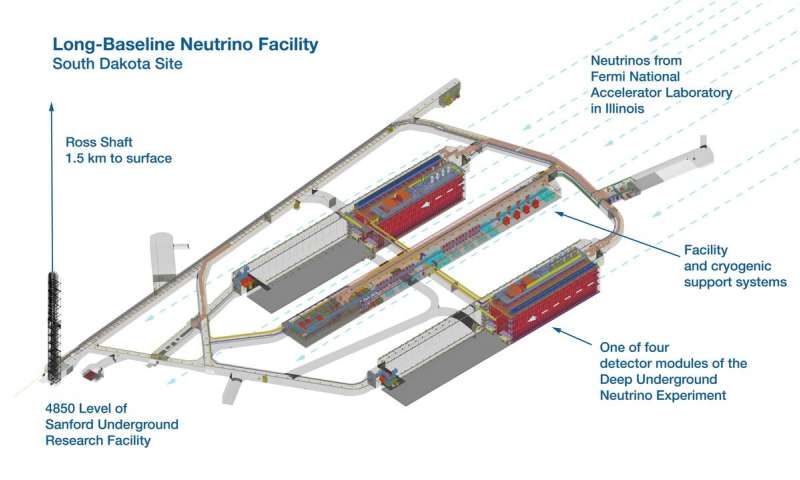
The DUNE (Deep Underground Neutrino Experiment) is made of two massive neutrino detectors 1300 km (800 miles) apart, one at Fermilab in Illinois and one at the Sanford Underground Research Facility in South Dakota. The near detector in Illinois will be 60 meters (200 feet) underground. The far detector modules will be 1.5km (about a mile) underground at the Sanford lab.
Neutrino Detection
Neutrinos are also called ghost particles, they go through almost everything unnoticed and move at almost the speed of light. There are three types of neutrinos: electron, muon, and tau. The near detector will show neutrino beams right after their creation which will allow scientists to search for new particles and subatomic phenomena. After the neutrinos are through the near detector they will turn into one of those three types. The far detector will be the most technologically advanced and largest liquid argon detector holding 70,000 tons of liquid argon and being 20 times larger than other detectors of this kind.
What is the DUNE Experiment?
Learn More About This International Experiment for Neutrino Science
News
